
In the United States, where I live, from the end of November through New Year’s, people are expected to constantly dwell in—and have our behavior reflect—a hyper state of consumerist overdrive. We’re bombarded with advertising messages that tug at our deep-seated fears of inadequacy, which try to force us to be in a state of constant activity (and consumerist spending), thereby going against the wisdom whispered to us by our bodies and against the messages of Nature during what should be a quiet and calm, unhurried season.
This isn’t the time to be totally oriented outward. Taking our cues from the natural world, our only real job is to go within and spend time in quiet, soul-nourishing contemplation. Instead, we find ourselves hurried, emotionally and financially depleted, and anxiously wondering what fresh hells await us in the year ahead as late-stage capitalism continues to undergo its virulent death throes.
Slavic Native Faith offers us a better way: the rites of Koleda.
Midwinter: a season of time-honored customs and celebrations
Some scholars argue that this weeks-long winter festival derives its name from the ancient Roman Midwinter celebrations of Kalendae, which, in the fourth century C.E., were extended to New Year’s Day and fused with the Kalends (beginning of the month) of January (Matthews 24). The various Slavic nations’ names for this festive period—Polish Kolenda or Szczodre Gody Kolęda, Russian Koliada, Ukrainian Коляда, Czech Koteda—are cognate with Kalendae, as is the Serbo-Croatian Koleda.[1] However, Koleda and its equivalents in other Slavic languages are also cognate with the Proto-Slavic (and current Serbo-Croatian) term *kolo, which means “wheel” (Cvetković 191).
“[The Solstices] have always been recognized as mysterious, shadowy, uncertain times, when the conviction that the sun would return becomes doubtful, and when the gates between the worlds stand ajar.”—John Matthews, The Winter Solstice: The Sacred Traditions of Christmas. Wheaton, IL: Quest Books, 1998; 15.
There are numerous multi-generational customs that are unique to each region and could serve as material for a book in and of themselves, but two elements stand out as pan-Slavic and will be reflected in the ritual I’ve composed that follows: first, the bringing in of the Yule “log,” whether it’s known as the badnjak/бадњак (Serbian), didukh/дідух (literally “grandfather” in Ukrainian), or Polish podłaźniczka, to cite a few examples; and second, the tradition of chiefly animal-masked carolers going from house to house, accompanied by the din of drums and bagpipes (Serbian gajde), who are rewarded for their songs and performances of their ritualistic, often ribald little skits with food, drink, and money by the hosts.
Both of these elements have their foundation in the cult of the ancestors, which shouldn’t be surprising at all as the perceived presences of the dead would naturally be associated with the darkest time of the year.
In Chapter 2 of my soon-to-be-released book, Slava! Slavic Paganism and Dual-Faith Folk Ways, I discuss how the Slavic World Tree is an oak (храст/hrast inSerbian; scientific name of Quercus cerris), and it’s precisely the wood of a healthy, young, east-facing oak that is ritually cut and welcomed into the house to serve as the Yule log.
Traditionally done by the head of the household or oldest male family member, the wood-chopping (note: the entire tree is not cut down, just a sizeable limb whose branches still have leaves attached) is preceded by prayers and offerings and should take place in the morning (Bandić 295). “The badnjak is the incarnation of the young God reborn after the winter solstice, and it symbolizes his resurrection on the eastern side of the world from the black depths of darkness,” explains Balkan witch Radomir Ristić.[2]
The return of the head of the household with the prized badnjak has a ritualistic element that bears a similarity to Scottish New Year’s Day/Hogmanay customs associated with greeting the luck-bringing “first footer” into the home: the awaiting family members welcome the good fortune of the greeter at the threshold, and subsequently invite that person inside only to pelt them with coins and walnuts, the food of the dead.
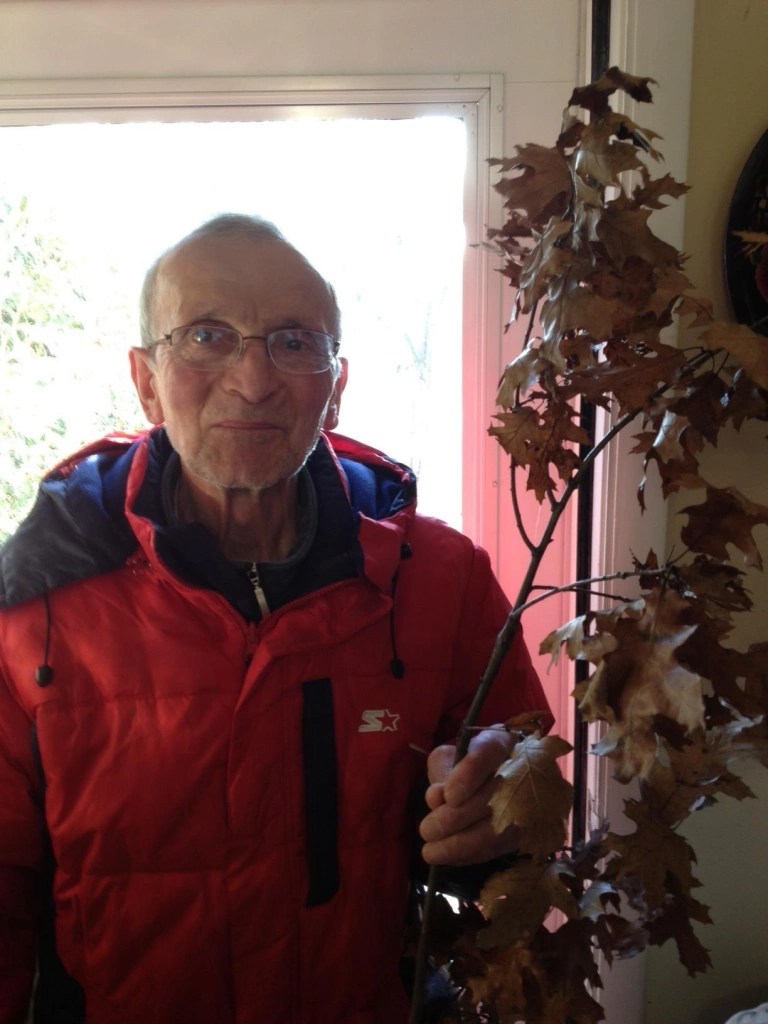
In other words, the family welcomes the return of the ancestors with symbolic tokens of the blessings that originate in the ancestors’ Underworld: wealth and sustenance. The song that is sung by the family, as you’ll discover, while this cheerful action is taking place is strikingly Pagan and deeply moving, for the badnjak is literally hailed as a “cousin to the Slavic people”!
Spoiler alert: the masked carolers—variously known as koledari (Serbia), kolendraši (Croatia), kukeri (Bulgaria), kurenti (Slovenia), kolyadniki (Ukraine)—singing as they go from house to house in the village streets are themselves personifications of ancestral spirits. Their leader, who is affectionately given the title of “Dedo” or “Grandfather” (cognate with the Ukrainian Didukh, the Yule log that features the harvest’s last sheaf of grain), thus takes on the role of Veles (Cvetković 231).
It’s a folk artistic and ritualistic homage to the concept of the Wild Hunt, but instead of coursing through the winter night skies as dangerous beings, the human dead and various animal spirits and their Leader are merrily trouping through the lanes of their respective Slavic villages and towns, bringing blessings to all who are ready to invite them in across the threshold. Fortunately, Slavic Native Faith groups in Serbia and elsewhere are reviving the tradition of making these remarkable costumes by hand the way their forebears did, using organic materials such as cow horns and hide, sheep skins, wood, and dried out gourds.[3]
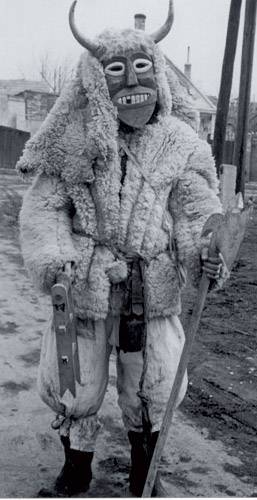
Traditionally, the koledari were an all-male ensemble and any female character’s roles, most notably that of Nevesta, or “Bride,” who is costumed as a pregnant woman carrying a distaff, were done in drag. The troupe would gather at the home of the lead male who plays the role of Deda/Grandfather and would begin their noisy village procession at midnight on the Eve ofKoleda (January 1), clanging bells and beating drums. If invited into villagers’ homes, the koledari, also “armed” with wooden swords and makeshift clubs, would attempt to flush out “demons” from their hiding places (again, masked actors from the troupe) in the home and then dance a victory kolo dance before blessing the household (Stefanović para. 2). As a reward, the family in residence would gift thekoledari with various foods and perhaps a choice bottle of home-brewed rakija (plum brandy).
While many believe that the flushing out of evil spirits part is a Christian addition to a far-older tradition, the idea does have its basis in pre-Christian beliefs of “unclean” spirits or spirit manifestations of the “Unclean Force”/Nečistaja Sila being especially rampant during winter time (Ivanits 39, 45). In fact, in the Serbian folk calendar, the holiday of Christmas itself (on January 7) falls squarely into this two-week period that is still called the “Unclean” or the “Unbaptized Days”: Nekrštani Dani (literally “The Days Devoid of the Cross”). That is why the late winter water purification rituals that became grafted onto Orthodox Christian celebrations of the Epiphany were and are so important.
With all of these rich layers of traditions and customs to unpack, it’s up to you to decide how “traditionally” you would like to observe them. The dates for the ritual that follow can fall anywhere between Winter Solstice Eve to well into the first week of January—or the second week of January for that matter, when the Julian calendar-observing Orthodox world observes the “Old New Year’s Eve” of January 13!
And certainly, there’s no need to adhere to an all-male koledari troupe either. In fact, it might be more than appropriate to have an actual pregnant individual cast in the role of the distaff-wielding “Bride,” as she’s clearly channeling the energies of Mother Earth’s blessings of fecundity and a good destiny for the household (making her a vessel of Mokoša, Weaver of Fates in addition to being the Earth Mother). As you reflect upon when and with whom you’d like to perform the ritual below, consider having these supplies on hand:
- Appropriate masks, wigs, makeup, and costumes/outfits (use clothes you were planning on purging from your wardrobe anyway!) to denote the various characters, from Deda (Grandfather) and Baba (Grandmother—she’s got to have a classic Slavic babushka scarf tied around her head, of course!) to the various winter animals (wolves, bears) to the “devils” personifying the unclean force that reigns this time of year; lastly, there’s Nevesta, the Bride.
- Props to consider include toy pitchforks for the devils, wooden swords or crude clubs (I’ve used my Irish blackthorn shillelagh to great effectas a demon-chasing club in past koledari processions I’ve participated in!), an actual bridal veil for Nevesta in addition to a handheld distaff, and a shepherd’s crook for Deda. When strapped for resources, plain wooden dowels from your local hardware store can work wonders with just a little imagination!
- Decorations on the feast table can include plates or small bowls containing navel oranges, cash (paper currency and coins), sheaves of wheat, hazel nuts, and walnuts (and a nutcracker or two), in addition to figurines depicting Deda Mraz/Deda Mroz (Grandfather Winter), a decidedly different persona from the Santa Claus so familiar to Westerners. My Deda Mroz hand-carved and -painted wooden figurine from Russia depicts a Nativity scene on his belly!
- Musical instruments ranging from cowbells and anklets with bells on them (popular in classical Indian dance/Bharata Natyam) to hand drums to wooden clapsticks and clackers.
- A medium-sized, portable, ceramic or stoneware bowl filled with pure spring water that has fresh or dried stalks of rosemary and basil in it to use as an aspergillum. This bowl will be carried carefully by a responsible koledari singer (someone not playing the roles of Deda, Baba, Nevesta, or any of the demons).
- A handsaw or hatchet for felling the badnjak/Yule log.
- Offerings of a small jar of honey and a bottle of rakija, brandy, mead, whiskey, or other strong alcoholic beverage as payment to the oak tree from which the badnjak is being cut.
- A couple of pounds or a kilogram’s worth of walnuts in the shell.
- A pair of gloves into which grains of millet, wheat, rye, or barley are stuffed into some of the fingers. This will be worn by the “first footer.”
- Straw for placing in the corners of the room where the badnjak will be housed when brought indoors. If you live in North America, try to get a small “hay bale” arts and crafts stores start selling in early autumn as the Halloween retail season gets underway. If you have the luxury to wait for Serbian Christmas Eve (January 6), you can freely grab fistfuls of such straw from any Serbian Orthodox Church’s floor and stuff them into your coat pockets—I’ve done that before in a pinch and people won’t look at you like you’re weird—just be sure to time your visit before Divine Liturgy is performed in the evening. Also, it’s polite to give something back if you take, so consider making a small cash donation in the alms box for the poor or leave money in the area by the nave where beeswax tapers can be purchased. You don’t need a huge amount of straw—its presence is symbolic for welcoming the ancestors (as are the walnuts).
- A dish of coins of your local currency at the ready; this will pelt the first footer who bears the badnjak.
- A large candle set in a fireproof container to represent the ritual fire; if you have a wood-burning fireplace or stove, by all means, use that instead.
- Incense and something to burn it in. This is for blessing/welcoming the badnjak and consecrating the table where the Koleda feast will be held. Traditional incense would be resin-scented bark from actual spruce or fir evergreen trees lit on charcoals, but any loose grain incense you fancy will work. In Serbian Orthodox Church services, the granules burned in the censers carried by assisting clergy are frankincense mixed with rose. Dried rosemary leaves and hyssop flowers would also make for appropriate apotropaic herb choices. To add money mojo, toss in a dried bay leaf—but be sure the space is well-ventilated, as bay leaf smoke is quite opaque.
- On the Koleda feast table, ensure a seat and a place setting is there for the beloved dead—white plates/bowls are traditional. The boiled wheat dish of žito (see Appendix D in my book for the recipe) is a traditional ritual food staple that should be made the day before this ritual will be held.
- Small/kitchen-sized fire extinguisher or fire blanket for safety.
- Statues or other images depicting the Slavic Deities Veles, Mara, Triglav (Their images will be on the floor near where the badnjak will be placed) as well as Perun and Svarog (Their images can be atop the feast table).
- Drinking horn with its tabletop stand. The libation chosen is something everyone can agree upon as suitable for all present, taking into account peoples’ ages and whether or not they can or desire to consume alcohol. My rituals tend to skew child-free so I favor a good mead like Danish “Viking Blod” mead under the Dansk Mjød label. Have a spare drinking vessel with non-alcoholic alternative such as fruit juice, apple cider, etc.
- A round loaf of freshly baked bread—pogača if you can bake it yourself (see Appendix D in my book for the recipe) or obtain a loaf from a Serbian delicatessen.
- A bowl large enough to accommodate the libations and other offerings that will be presented to the Deities and spirits.
- Optional: firewood (oak logs are ideal) and kindling, matches, if the space has a wood-burning fireplace or pečina (wood-burning stove common in older Slavic homes, especially ones out in the country). There should be enough wood to last for a 24-hour period with a dedicated fire-tender keeping vigil.
- Optional: patio umbrella stand or Yule tree stand for propping up the badnjak limb vertically.
the rite
This ritual has two parts: a morning and an evening portion, ideally done in the same 24-hour period. The celebrants should have determined in advance which person or family will be hosting this ritual at their home. The person who is either the homeowner, or the eldest able-bodied person in the family, should set off alone with their handsaw or hatchet and offerings for the oak tree from which they will swiftly and neatly slice off a leaf-baring limb that will serve as the badnjak. It’s ideal if they obtain it from a secluded spot in nature, such as a forest. Please be mindful of not trespassing on private land. This should be done as early in the morning after sunrise as possible; the other celebrants will remain at the house and have their fistfuls of walnuts and coins at the ready.
The badnjak “hunter” should find a young (not a sapling!), healthy, straight-growing oak of whatever variety (where I live in far northeast Illinois red oak [Quercus rubra] is the most abundant species) that is aligned with the cardinal direction of East. The celebrant should take a few deep breaths facing that direction themselves and really focus on the sanctity of the occasion. Then they are to take a moment and connect with the tree literally by placing their forehead against its trunk, while praying this or a similar prayer:
“Oh young and healthy Oak Tree, it is I, your cousin [STATE NAME], greeting you on this hallowed Badnji Jutro[4] to celebrate the rites of Koleda! The kin have assembled and we are ready to welcome you with great gladness. If it be your wish to join us, we would be honored!” [PAUSE A MOMENT TO FEEL IF THE ENERGY OF THE TREE IS RECEPTIVE. IF NOT, COME BACK ANOTHER DAY OR TRY A DIFFERENT TREE.] “As thanks for your sacrifice, I bring you the gifts of sweet honey and a libation of [NAME BEVERAGE]. Slava Rodu!”
The celebrant kisses the tree.
The limb chosen should be growing towards the east and sawed or chopped off cleanly and as quickly as possible on its eastern side, slant-wise and with minimal sawing motions or hatchet strikes. Instead of letting the limb fall to the ground, the celebrant should have it in their hand the entire time. Propping up the limb against the trunk, the celebrant then immediately pours out the contents of the honey jar and the libation at the base of the tree, saying these or similar words:
“Life, sweetness, joy: May the manifold blessings of my cousin return to them a thousandfold! Grow strong, tall, and live for hundreds of years, dragi Hrast/beloved Oak! The Gods protect you and keep you! Slava Rodu!”
The celebrant then takes the containers of the honey and alcohol with them for proper disposal/recycling at home. They carry the limb of the badnjak in their dominant hand in total silence back the way they came/to their transport home. Now even if they’re left-handed, as they approach the main entrance to their home where the other celebrants are awaiting them behind the door, they must, per proper “first footing” custom, carry the badnjak in their right hand. With their left hand, they knock thrice on the door.
One of the celebrants inside or everyone there in unison: “Who is it?”
First footer: “The one bearing badnjak blessings of life, health, wealth, and well-being to all who dwell herein.”
All inside in unison: “Enter, friend, and be welcomed here!”
A celebrant goes to open the door. The first-footer removes a glove from their dominant hand and sprinkles the grains from the fingertips onto the threshold.
Now this is important: The first-footer must consciously step across the threshold right foot first.
First footer: “Srechan [сречан] Koleda!” They then strike the floor thrice with the end of the badnjak limb.
All inside in unison: “Bogovi vam pomogo! / The Gods ever help and attend unto you!”
Then the celebrants joyfully pelt the first-footer with their fistfuls of coins and walnuts, hooting and cheering as they do so. Next, they circle around the first-footer while holding hands and chant the following:
“Badnjače, Badnjače, Slovenski rodžaće, dobro nam došli u našu kuću[5],” which means “Oak, Oak, cousin to the Slavic people, you are welcome in our house!”
One of the celebrants takes the badnjak limb from the first footer into their right hand and they take it to the southeastern corner or eastern wall of the indoor space. There should be straw on the floor and any images of the Deities Veles, Triglav, and Mara, if desired. The drinking horn filled with its libation and the bowl designated to have offerings poured into it should also be on the floor. If a tree or patio umbrella stand isn’t being used, carefully prop up the badnjak limb against the wall or nestle it in the southeast corner. Everyone gathers around where the tree limb goes. This celebrant then says:
“At this holy time of Koleda, we give thanks to our ancestors and to our Powers of the Lands Below. You Who serve as the roots of our sacred World Oak, we give You our thanks and praise! May You be nourished in turn as You nourish the Slavic people, not just with food and the manifold earthly blessings that sustain our lives, but with the wealth of wisdom as we drink deep draughts from the Well of Ancestral Memory. Slava Rodu!”
All: “Slava Rodu!”
The celebrant who spoke raises the drinking horn before the tree and pours about half of the horn’s contents into the offering bowl. This person then passes around the drinking horn for everyone to take a sip out of. If children or folks who cannot have alcohol are present, ensure there are two vessels with libations and the second one can have fruit juice or another viable non-alcoholic option. In my Gardnerian coven days a quarter of a century ago, there were always two chalices passed around at Sabbat and Esbat rituals, with the High Priestess and High Priest jokingly distinguishing between the chalices’ proffered contents as “regular” or “unleaded”!
Celebrants individually can come forward at this time with their offerings of oranges, walnuts, and money to be placed around the Deity images, thanking the Powers in their own ways for the acknowledgement of received blessings.
A different celebrant lights the incense and proceeds to fumigate the badnjak. They say: “Hallowed are you, dragi Hrast/dearest Oak! You chase away winter’s gloom and warm our hearts and our hearth with your presence. Yours is the precious reminder of the renewal of light and of life at this time of Koleda. Slava Rodu!”
All: “Slava Rodu!”
That celebrant continues: “May we each in turn purified be and from the clutches of all that is unclean, set free.” They then pass around the incense and holder for the rest of the celebrants to fumigate themselves in the manner they best see fit, with parents fumigating their children, should children be present.
The incense (add more to the burning charcoal disk, if necessary) and holder are now passed to one of the homeowners/residents of the home hosting the rite in their space. That individual and everyone else circle around the table where the feast will be held in the evening. The celebrant with the incense fumigates the feast table, saying:
“Hallowed is this table and the feast it will host. We give thanks for the bounty of food and for the fellowship of kindred and friends—living and dead—in the Circle of Rodu. Ancestors, ascend and take your seat at the table. Beloved Gods, descend from the heights of the Tree—Svarog with Your light and Perun, cloaked in justice—and be welcome among those who reverence You at this time of Koleda and always! Slava Rodu!”
All: “Slava Rodu!”
If a wood-burning fireplace is available in the space, the homeowner/resident goes to light it, stating, “A budnik[6] for the badnjak: may the one who keeps vigil at this sacred time of Koleda invite the blessings of fire for this hearth. Fire for light as balance to the darkness, fire for warmth to keep the cold at bay, fire for the strength and health of all gathered here, fire for the Božić—the Young God—to light His way! Slava Rodu!”
All: “Slava Rodu!”
Note: At dusk the fire-tender will snip off a branch from the badnjak, and, with everyone present, add it to the fire, declaring, “However many sparks, so too the levels of happiness in this house. However many sparks, so too the hundreds of dollars in our bank accounts. However many sparks, so too the number of sheep in their pens and chicks in the henhouse. However many sparks, so too the vats full of wine. However many sparks, so too our health and joy, now and throughout the new year! Slava!”
All: “Slava!”
The ashes gathered from this fire are extremely valuable in apotropaic magic and ought to ultimately be distributed to everyone who participated in Koleda. Consider getting red flannel bags with their little drawstrings to ultimately house a portion of the fire’s ashes—one bag with ashes to each adult.
If there is no fireplace or wood-burning stove, the fire-tending celebrant can light the ritual Koleda candle. The candle should ideally be in a safe container and burn for at least a day, so a plain multi-day white wax candle in glass (commonly available in many U.S. grocery stores in the Hispanic foods aisle, or the section in your local Walmart where candles are sold) set atop a fireproof dish on top of the feast table will suffice. Never leave a burning candle unattended and please ensure neither the little hands of wee ones nor mischievous and curious kitties have access to the candle.
The person lights the candle, stating: “Fire to light our Koleda rite! Svarozich, Young Sun, come! Your kin are gathered before You here, the badnjak has been set in its rightful place, and our feast will soon be ready. Strength and life to You on Your journey through these cold skies, Son of Svarog! Be with us as we celebrate the Mysteries of Koleda! Slava Rodu!”
All: “Slava Rodu!”
As the day advances, activities appropriate for the day include exchanging gifts, storytelling, working on arts and crafts projects, baking and cooking the menu items to be shared in the evening feast (see Appendix E in my book for some of my family’s traditional Serbian recipes), making offerings to the house and land spirits, and, weather permitting, outdoor games such as tug-of-war (team Perun versus team Veles?). Hot soups and herbal teas and perhaps a shot (or three!) of hot-off-the-stove rakija all translate to cozy winter cottagecore vibes.
The evening portion of the Koleda ritual can begin as soon as the onset of dusk, which may be great timing for parents mindful of children who have to be marched off to bed by a certain time. The celebrants should have determined in advance which of them will comprise the koledari troupe and which ones will remain at the house to prepare the feast and welcome the koledari. The roles up for grabs are Deda, the leader, a proxy of Veles; Baba, the Grandmother, a proxy of Mara; Nevesta, the Bride, a proxy of Mokoša; two or three cutesy (so as not to scare any children present) “devils”/representations of the Unclean Force; with the remainders being the animal-masked singers, one of whom will be responsible for carrying the bowl of spring water.
The koledari troupe should process from a considerable distance away, as is reasonably possible. Let the din of their instruments and voices ringing in the crisp air be heard. The celebrants portraying the “devils” need to stay behind with the host celebrants and hide somewhere in the vicinity of the host’s home, in an obvious place such as under the feast table, behind the living room curtains, etc.
The koledari chant or sing the following verses in a loop:
“Winter darkness now is here,
Yet we march and have no fear.
From house to house, we bring our cheer—at this Koleda time!
Inbetween the Worlds we go,
Stomping, laughing through the snow!
No cares have we nor any woe—at this Koleda time!”
The koledari pause before the ritual host’s home and repeat the above chant. The celebrants inside the house come to the door, open it, and stand outside to greet the masked singers.
Ritual host: “Greetings, travelers from the forests from beyond the edge of the world, you who have come from far beyond the blood-red sea! Welcome, Deda and Baba! Welcome, Nevesta, mother-to-be! Welcome, Gospodar Vukova, the Lord of the Wolves, and his retinue of the spirits of the animals who guard the paths of our folk-ways! Welcome, ancestors looking to be fed! Here will you find warmth and welcome, and a place to rest your weary feet. Come join us for our Koleda feast; come in from the cold, come in from the street!”
The koledari enter and everyone circles the feasting table.
Deda: “Good evening, koledo! Head of the household, koledo! Keeper of the badnjak so blessed—gladly with you would we feast and rest! In exchange for your kind hospitality, for our supper we now sing: jedan [one], dva [two], tri [three]!”
All koledari: “Good evening to this household, to all who keep it in good stead!
May your pantry be overflowing with mead and meat and bread!
May health and wealth attend you,
May your lives be filled with cheer!
May the Gods ever defend you
This Koleda and throughout the year!
We’ve journeyed far to call on you—
Bring out the wine glasses, fast!
You have our blessings tried and true
For cherishing customs from the past.”
Baba (raising hands in benediction): “Though the north winds may bite as Stribog carries Mara into our midst, may you be enchanted by winter’s icy, snow-blown beauty. No hardships will have a hold over this house. Slava Rodu!”
All: “Slava Rodu!”
Nevesta (raising hands in benediction): “Though the daytime skies may be clad in iron grey, be not dismayed. New life will we see in lengthening light and bud of tree. May all who dwell herein, humans and beasts, wax in strength and health as the strengthening Sun mirrors the light within us all. Slava Rodu!”
All: “Slava Rodu!”
Celebrant carrying the bowl of spring water: “Before my blessing I can with certainty say, I advise my fellow koledari to first drive the unclean spirits among us far away!”
And at that cue, the “devils” emerge from their hiding places and the koledari engage in mock combat with them, devil’s pitchfork against the koledari wooden sword and club, and Deda’s shepherd crook.
One of the devils: “Our weapons cannot smite but theirs sure do bite! Let us be off without delay, to our Master’s I say! We must be gone ere break of day!”
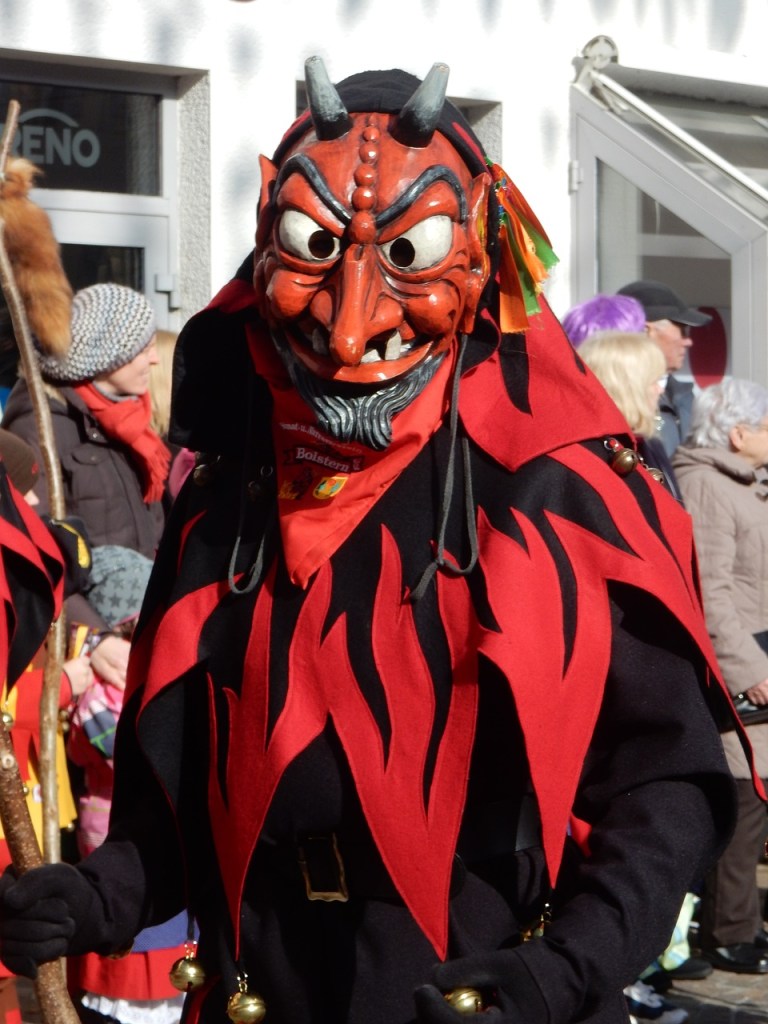
Exeunt devils from the house. The celebrant carrying the bowl of spring water begins to individually bless the hosts of the ritual/homeowners first and then the koledari troupe members with the words and by sprinkling them with the rosemary/hyssop aspergillum: “Behold, the Waters of Life. May they cleanse and renew you. The Unclean Force cannot claim you nor anyone in this space nor this space itself. No miasma can coalesce here. This space is pure and you are pure, you are pure, you are pure. And so it is! Mir svima—peace to all this Koleda night!”
All: “Mir svima!”
The koledari troupe members formerly disguised as devils return to the house, having already removed their masks/accoutrements. They join everyone else gathered around the table.
The host/homeowner speaks: “From Badnji Dan to Badnjak Veče: This is the Night of the Oak. May we evoke the blessings of our Cousin Hrast [Oak] now!”
The host goes to snap off a leaf-bearing twig of the badnjak and holds it over his head, blessing it with a hearty cry of “Slava Rodu!”
All: “Slava Rodu!”
As the leaves begin to snap and crackle in the flames of the fireplace/wood-burning stove, everyone says: “The badnjak burns and the Sun-Wheel turns! Slava Svarog! Slava Svarozich!”
The celebrant who played the koledari role of the Baba goes to the place setting for the dead and says: “On this holy night, I call upon our ancestors of blood and bone, our forebears going back generations upon generations. May they be present with us now. I welcome them to their place at the table. May they partake of the food and drink set aside for them. May they bless us, their descendants, and smile kindly upon our work to restore the Old Ways. Slava!”
All: “Slava!”
Another celebrant prays: “For the interconnectedness in our all-encompassing Circle of Rodu, we give thanks. For the harmony between the living and the dead, we give thanks. For the wisdom of our elders translated into actions of the here and now, we give thanks. For the Gods of old Who are with us now and always, we give thanks. For the help of the spirits of home and land, we give thanks. For the animals whose companionship enriches our lives, we give thanks. For the abundance in our lives reflected in the food made by various hands that we will shortly eat, we give thanks. For the darkness in which we’ve gathered with the promise of the ever-returning Sun, we give thanks. Slava Rodu!”
All: “Slava Rodu!”
The feasting can now begin. Enjoy! The plate of food for the dead and any beverages left out for them must remain on the table overnight, even if everyone else’s plates and cups have been cleared away. In the morning the ashes from the fireplace/wood-burning stove can be swept up and distributed into the little charm bags that will be given to all the adults who participated in the rite.
Midwinter blessings to all!
Mir svima! May peace prevail on Earth!
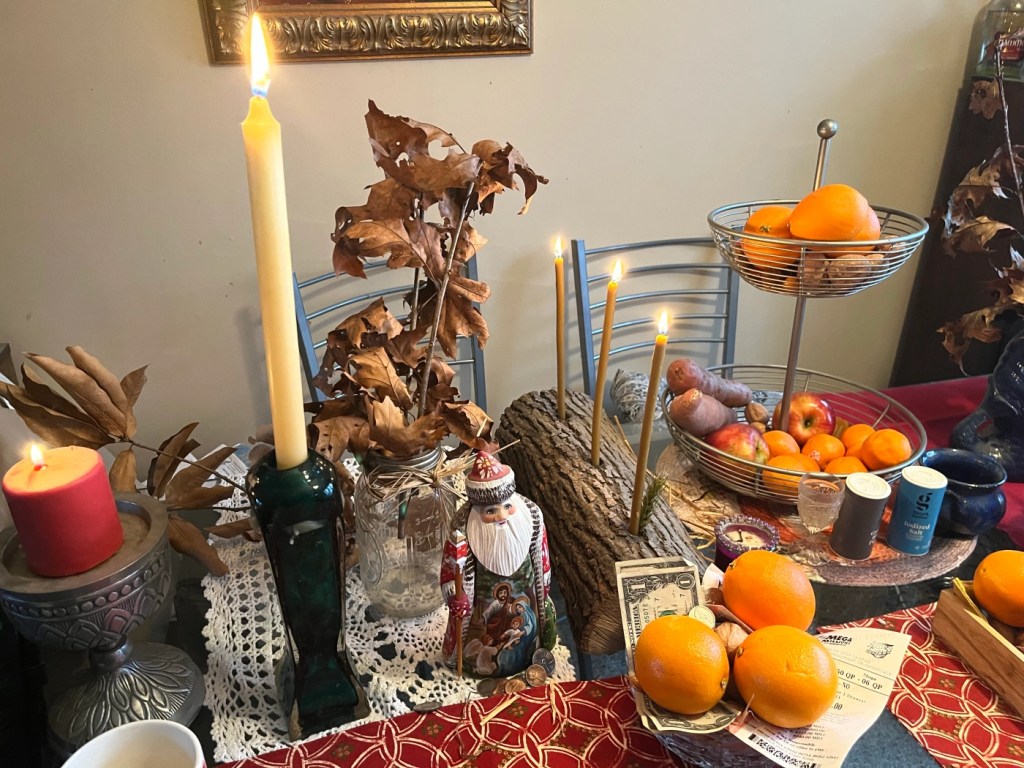
My dining table set for Badnji Dan, 2024, (c) Anna Urošević Applegate.
works cited
Bandić, Dušan. Narodna Religija Srba U 100 Pojmova. Beograd: Nolit, 2004.
Cvetković, Stefan. Slavic Traditions & Mythology. Independently published, 2021.
Ivanits, Linda J. Russian Folk Belief. Armonk, NY: M.E. Sharpe, Inc.: 1989.
Matthews, John. The Winter Solstice: The Sacred Traditions of Christmas. Wheaton, IL: Quest Books, 1998.
Stefanović, Vladimir. “Serbian Christmas Traditions.” https://www.crkvenikalendar.com/tradicija/bozic_en.php. Accessed November 17, 2024.
footnotes
[6] Pronounced “BŌŌD’-neek.” It is a term for one who stays awake in vigil; gendered masculine as a noun. The feminine case would be “budnika.”
[5] The pronunciation of the phrase is “BAHD’-nyah-cheh, BAHD’-nyah-cheh, SLŌ-vehn-ski ROAD’-zhah-cheh, DŌH-bro nahm DOE’-shlee ooh NAH’-shoo KOO’-choo.”
[4] Pronounced “BAHD’-nyee YOU-trōw”; it literally translates to “Oaken Morning.”
[3] Check out the Serbian Rodnover group Lug Velesa (“Valley of Veles”) on YouTube. Their 2013 video “Izrada koledarskih maski / Making of Koleda ritual Slavic masks” shows wonderful craftsmanship in the time-honored techniques using rustic materials. Available at:https://www.youtube.com/watch?v=R9y8d6ZSdmw&list=PLMLCzLtzN6X8WqNIe1PGZdd69urCxWHsG. Accessed September 17, 2024.
[2] Ristić, Radomir. Balkan Traditional Witchcraft. Los Angeles: Pendraig, 2009), p.279.
[1] And among the Slavs’ closest cultural cousins of the Balts, the festival period also has a similar name: Lithuanian Kalledos; Latvian Kalladū.


Leave a comment