
In Serbian Orthodox-informed Dual-Faith or Dvoverovanje, the period leading from the end of July to the beginning of August is a hazardous time. For rural folks in Serbia and elsewhere in Eastern Europe, it’s an intense time of arduous physical labor to process the harvest. It’s also a spiritually precarious time where the goal is to avoid the unwanted attentions of the pair of folk saints known as “Fiery Mary” (Ognjena Marija) and her “brother,” Sveti Ilija/Saint Elijah. Searing drought or a dangerous hailstorm sent by either of them can destroy the as-yet-unharvested crops.
Soaring temperatures at this time of the year, whether in the Balkans or the Midwest USA (the greater Chicago area has been roasting the past couple of weeks with heat indices past the 100° F mark), can certainly augment a collective sense of anxiety. Serbian folk beliefs pertaining to this pair of “Fire Saints” takes on a whole new level of alarming significance in this age of undeniable climate change and globally destabilized weather patterns, one of whose manifestations is the preponderance of out-of-control wildfires that last for months at a time.
a slavic sky goddess in disguise? the folk saint of “fiery mary”
A cursory look at the folklore surrounding “Fiery Mary” and Saint Elijah can translate into fascinating case studies of much older, fiercer, earth-spirituality-centric Powers subsumed into the Dual-Faith visual representation of Byzantine iconography. The fixed date of July 30 (per the Julian calendar) marks the Feast Day of Ognjena Marija. As seen in this 15th-century Russian Orthodox icon below, her prominent hexafoil fire motifs and her stern visage give her away in Orthodox icons, signifiers that are consistent in color symbolism and artistic form from Serbia all the way northeastward to Russia.
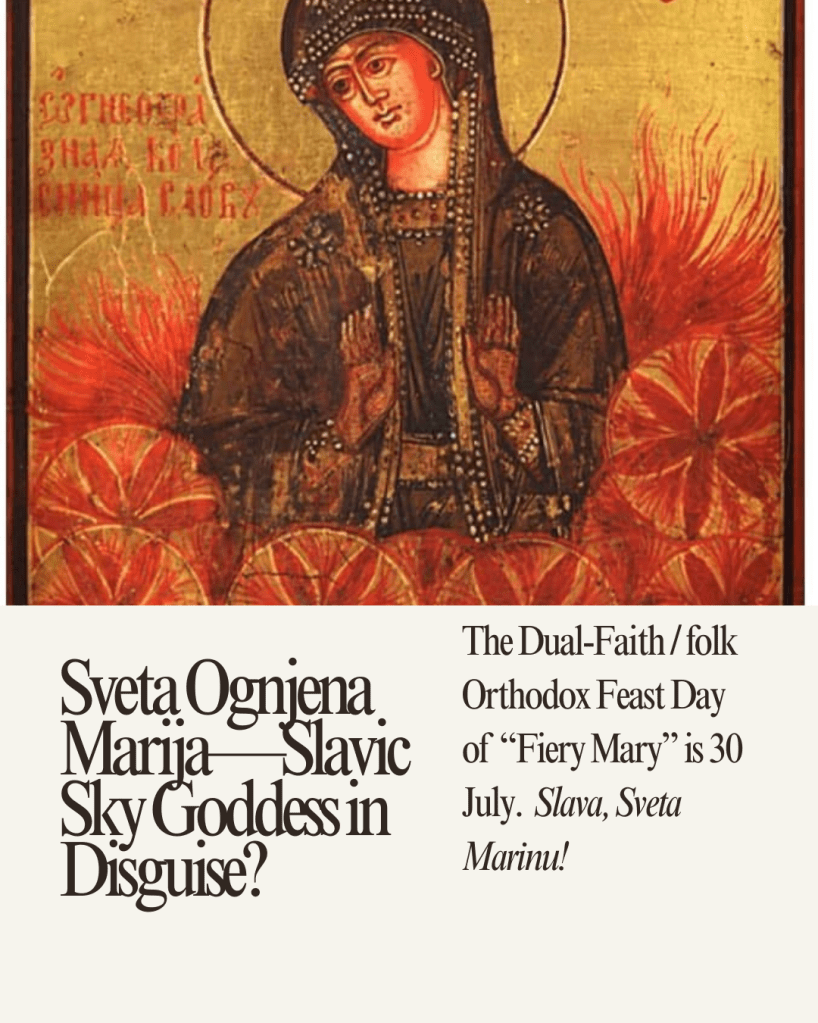
As is the case with many other Slavic folk saints, the details from her official hagiography are scant. Sveta (“Saint”) Marija, who also goes by the name Marina, is referred to in Serbian catechetical lore as a Velika Mučenica—a “Great Martyr.” She hailed from the ancient Phrygian city of Antioch. She was put to death, supposedly for rejecting Pagan suitors, sometime during the reign of Emperor Diocletian (284-305 C.E.). The official story doesn’t have much else to say.[1]
Fortunately, the folk beliefs surrounding her abound in details that speak of a unique, perhaps mythologically unprecedented, Slavic sky goddess. She’s said to be the “sister” of the Old Testament prophet, Elijah. Sharing his quick temper and fondness for fiery cataclysms as a default response to human immorality, she’d gladly set the planet ablaze.[2] She is also said to use a heavy sledgehammer(!) to punish wicked people, smite devils, as well as hurl lightning, skills she shares with her “brother” and which certainly put us in mind of the Slavic thunder god, Perun. She punishes dishonest women by cursing them with infertility.
In rural areas of Serbia, various taboos rule her feast day and people know better than to do any serious chores—especially labor out in the fields. It’s best to stay indoors, period. And for women, that means no spinning of wool for use in the winter months to come, lest they draw the fiery ire of Ognjena Marija.
saint elijah the thunderer: avatar of perun
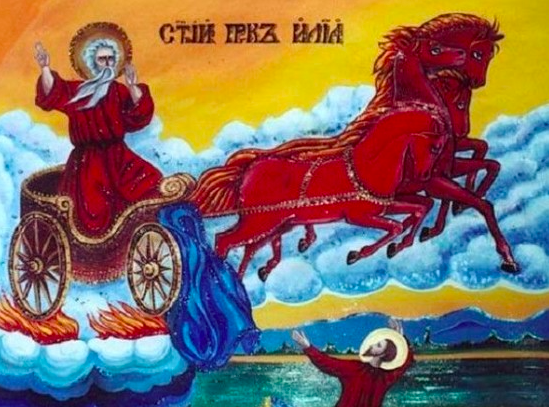
The Feast Day of Fiery Mary’s “brother,” Sveti Ilija Gromovnik/Saint Elijah the Thunderer, arrives two days later, on August 2 (Julian calendar; the Gregorian date is July 20). As the star Sirius makes its heliacal rising, bringing with it the hottest weather of the season, Sveti Ilija Gromovnik arrives in his chariot of fire, reminding us that the old Slavic thunder god, Perun, is remembered, honored, and more than a little feared in the guise of this Old Testament biblical personage.
Where I live, it does seem to almost always thunderstorm on August 2. From the time when I was a little girl to well into my adolescence, I would listen with rapt attention during thunderstorms to my mother’s tales of bad things that befell her neighbors in her hometown of Užice, Serbia—people who were punished at this sacred time of summer’s intensity. I heard stories of peoples’ orchards set ablaze in an instant during freakish storms and other sudden forms of loss incurred for violating the taboos of Sveta Ognjena Marija and Sveti Ilija.
It was even taboo, I learned to my astonishment, to make the Sign of the Cross during a thunderstorm! Sveti Ilija doggedly pursues the Devil around the world. Severe thunderstorms and lightning strikes occur when the fearsome saint, thundering past in his chariot, hurls his bolts like lances, hoping to zap the elusive Devil once and for all.[3] The cunning Devil knows that the normally effective apotropaic gesture of making the Sign of the Cross suddenly has no effect for the scared human hoping to keep evil away. Ever the opportunist, the Devil would like nothing better than to use a frightened child in a thunderstorm as a human shield. Making the Sign of the Cross can send the wrong signal—the Devil is hiding behind me! The “Thunderer” is pitiless and has no qualms with the concept of collateral damage ensuing from his righteous work. Thus, if Sveti Ilija were to hurl a lightning bolt, the child and not the Devil would be struck!
Eight-year-old me was horrified at the thought of being an unintended target of Saint Elijah’s wrath; during storms, whether at home or at school, I made sure to stay away from windows so as to not be seen by the saint passing overhead in his chariot of fire. And no matter how loudly the peals of thunder boomed and how frightened I became as a result, I never, ever made the Sign of the Cross to allay my fears and ask for Jesus’ or the Virgin Mary’s help in the moment. It was just too risky a move.
“If Ognjena Marija and Sveti Ilija had their way, the planet would be burned to cinders,” my mother would tell me, her eyes wide with alarm. “Totally destroyed! They love fire and will stop at nothing to punish evil-doers!”
Wow, the whole world! Those two mean business! My young imagination visualized horribly burned pizza crust and then magnified that a bazillionfold to calculate, in my mind, the scale of what the fiery destruction of the world would entail. It occurred to me that Saints Fiery Mary and Elijah seemed to be more powerful than God himself, who apparently chilled out considerably after that Great Flood business, at least according to what the Dominican nuns in my Chicago Catholic elementary school taught me. Jeepers!
As an adult, I’d say it’s quite clear that reverence for Saint Elijah took over the widespread cult in Slavic lands of the god of thunder and justice, Perun. A well-known pan-Slavic epithet for the god, as we’ve seen with the saint who arrived on the mythological sceen centuries later, is Gromovnik: “Thunderer.”[4]
We know that the World Tree in the Slavic cosmos is an oak, and it’s in the top-most branches where Perun, in eagle form or accompanied by an eagle, likes to perch before setting out in his chariot to cause storms that ensue from engaging in combat with his serpentine enemy, the god Veles, Lord of the Underworld, who is often coiled at or beneath the World Tree’s roots. This is where my mother’s stories stem from: during the Christianization of the Slavs in the late ninth to the late eleventh centuries, Veles easily became transformed into the Devil,[5] and the early Christian Slavs saw in the iconography of Saint Elijah the form that Perun would take as all the elements were there: thunder, the chariot of fire, and the hurling of divine wrath in the form of lightning bolts.
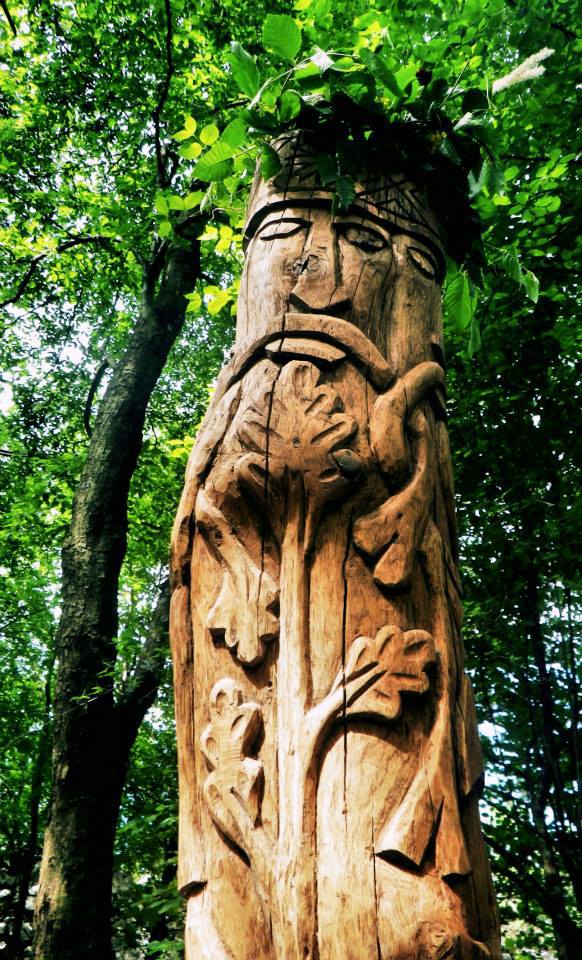
Was Perun the most important god worshiped by all Slavs before the conversion period began?[6] In the resurging Slavic Native Faith communities springing up in Eastern Europe today, Perun receives universal praise as the chief deity—he’s much more in the modern Rodnover consciousness than merely a god of storms. The centuries-old religious craft of carving god-poles as images of the gods meant to receive devotional offerings has been steadily making its way into public sites of worship again, from Poland to the Czech Republic to Croatia and Serbia to Ukraine and Russia.[7]
As the Serbian folk observances show, these folks saints and the gods who preceded them are dangerous and necessary, governing the tightly woven skeins of life and death, being and non-being, past and present. The destructiveness of Ognjena Marija and Sveti Ilija/Perun showcase the precariousness of life: a lightning-spawned wildfire can and does devastate late-summer crops in the fields. It does destroy homes. We approach these dread and majestic personages, if we know what’s good for us, with a generous helping of humility.
watery pacification courtesy of the magdalene: Blaga Marija

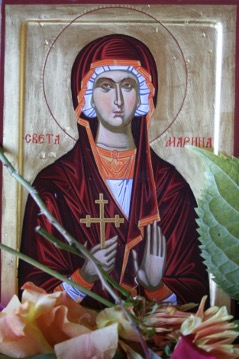
Perhaps if Sveta Ognjena Marija and Sveti Ilija had their way, the planet would, indeed, be engulfed in flames. But in the Serbian calendar, relief from destruction arrives two days after Saint Elijah’s Feast Day with the Feast Day of Elijah’s other “sister,” Blaga Marija, or “Mild, Benign, Gentle Mary.” She is equated with Mary Magdalene in Serbian Dual-Faith Tradition and she switches the Elemental focus from destructive Fire to healing Water.
In terms of the agricultural cycle, there’s a Serbian saying that goes: “Od svetog Ilije, sunce sve milije.” Translated into English (losing the clever rhyme scheme in the process), it means “From Saint Elijah’s Day onwards, the sun becomes more gentle.” If Ognjena Marija and Blaga Marija are two faces of the same primordial Slavic sky goddess, as some scholars suggest,[8] the switch from Marija’s ognjena (“fiery”) nature to her blaga (“benign”) one could herald the seasonal transition from summer to the first stirrings of autumn.
Sveta Marija Magdalena is first and foremost a protector of women. Serbian Orthodox Christians pray to her for healing, especially concerning reproductive issues. On August 4, her Feast Day, people make pilgrimages to one of many sacred springs and wells, found flowing beneath or adjacent to churches, that are named after her throughout Serbia. The devout seek holy water to anoint themselves with as well as to consume, either unceremoniously or in the context of a bajalica’s prescribed healing ritual. In rural communities, on the day of Blaga Marija, the taboos against laboring in the fields and chores involving the spinning of wool and other “women’s work” apply.
adapting the lore of the saints for today’s seekers: Suggested Spiritual practices
The most obvious adaptations of celebrating these folk saints’ feast days today entail rounds of spiritual cleansing, by fire and by water, respectively. On the dates of July 30 and August 2, I ask Saints Fiery Mary and Saint Elijah to purge and purify me, physically and spiritually, and to clear out of my life that which has served its purpose. I prefer to conduct my spell work at my indoor wood-burning fireplace or outdoors at my backyard fire pit.
When Blaga Marija’s Feast Day comes around, I enjoy taking spiritual baths to bring sweetness into my life. I’m also fond of excursions to nearby Lake Michigan, seeking out my favorite lonely beaches wherein I can meditate on the profound powers of Elemental Water. I tend to drink the Holy Water that I obtain at my local Serbian Orthodox monastery as a health tonic also. It’s also a traditionally appropriate activity to honor each saint on their Feast Day by cleansing their icons with Holy Water and adorning them with sprigs of fresh rosemary, hyssop, and basil—the trifecta of apotropaic herbs in Serbian folk magic.
[1] Bandić, Narodna Religija Srba u 100 Pojmova, 214.
[2] Any devotees of the Egyptian goddess Sekhmet will surely recall the myth known as “The Destruction of Humanity,” wherein Ra dispatches Sekhmet to incinerate the human race as punishment for wickedness.
[3] Marjanić, “Dragon and Hero or How to Kill a Dragon,” 129.
[4] Ivanits, Russian Folk Belief, 29.
[5] Marjanić, “Dragon and Hero or How to Kill a Dragon,” 129.
[6] Dvornik, The Slavs: Their Early History and Civilization, 48.
[7] Ivakhiv, “The Revival of Ukrainian Native Faith,” 230.
[8] Bandić, Narodna Religija Srba u 100 Pojmova, 215.


Leave a comment