
In the seasonal Dual-Faith calendar of Slavic countries that came to be outwardly spiritually colonized by the Eastern Orthodox Church, the week leading up to the great Feast of Pentecost is said to be the week of greatest power for the rusalki, the feared female-gendered water spirits (singular: rusalka) of Slavic folk belief. As a sign of them being at the height of their powers during this week of the year, rusalki–unlike their male water spirit counterparts of the vodanoi/vodeni duhovi–have the ability to leave their watery abodes of rivers and lakes and head far inland. They can be seen, especially by those born on a Saturday, dancing a kolo/khorovod in forest clearings or heard laughing and singing in trees.
Who are the rusalkI?
Hostile to humans, especially women, the rusalki punish those who trespass into their revels by driving them mad or making them physically ill to the point of death. Those unfortunate folks, in Serbian folk belief, are said to be “taken” by the rusalki.[1] Considered throughout all Slavic lands to be the souls of unbaptized babies or women or girls who drowned (in either case, they are the “unclean” dead), rusalki, despite their physically beautiful appearances that closely resemble their land-dwelling nonhuman cousins of the vile, are nevertheless regarded as another manifestation of the Nečistaja Sila—the “Unclean Force.”[2]

To this day in rural Serbia, protocols have to be followed, especially by women, for the entirety of Rusal’nalia Week to ensure that the rusalki stay away. Not only do women avoid bathing in rivers and their favorite local swimming spots, they don’t even come near the water, period. Nor do they court danger by napping outdoors. It’s also considered wise to avoid engaging in spinning, weaving, knitting, doing laundry, working around the house, and gardening for that entire week.
If those chores, especially ones done outdoors like gardening that would put you in the line of sight of the rusalki, can’t be avoided, the best insurance is to carry sprigs and roots of wormwood (Artemisia absinthium) on your person and have bunches of the herb on display throughout the house. This is the most apotropaic herb used throughout the Slavic world to keep the rusalki at bay.[3] Methods of rendering rusalki harmless include making the Sign of the Cross, proffering garlic, or enclosing yourself within a magic circle drawn on the ground. However, some women in East Slavic countries go the route of trying to appease the rusalki with offerings of linen hung in trees.[4]
The rusalka is certainly a more complex figure than her male counterpart of the vodenjak. Combining traits that apparently fuse the classical Greek mythological beings of the siren and the naiad with an indigenously Slavic forest spirit and with Christian folk religious superstitions about the dead who died unbaptized or unnaturally via drowning, the rusalka bridges the dualism that divides Slavic goddesses as being either forces of life (e.g., Vesna) or forces of death (e.g., Mara).
The rusalka is a dangerous being, associated with the “unclean” dead, yes, but her ability to leave her underwater domain for the land (at least during the spring and summer months) attests to her powerful, Goddess-given, life force–promoting critical function of bringing new life to vegetation. She transfers the magic of life’s inception, which occurs in water, from river or lake to forests and more importantly, to fields of grain.[5]
Singing to the hauntingly beautiful aria (“Song to the Moon”) in Act I of Czech composer Antonin Dvorák’s 1900 opera that bears her name, the rusalka captivates us as she carefully balances the waters of life and waters of death within her. In this regard, I think of her as a wholly Slavic version of the female divine being often depicted in the Tarot’s Major Arcana card of Temperance.
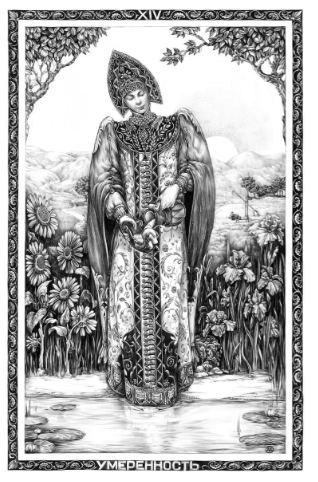
She provides us with much to meditate upon about the cyclical nature of reality and our own ways of marking our celebratory stations with each unfurling of the spiral. Slava!
[1] Dušan Bandić, Narodna Religija Srba u 100 Pojmova, 156.
[2] Linda J. Ivanits, Russian Folk Belief, 187.
[3] Bandić, Narodna Religija Srba u 100 Pojmova, 156.
[4] Ivanits, Russian Folk Belief, 75.
[5] Ivanits, Russian Folk Belief, 75.


Leave a comment